Micah: "I think I'll go to college and get a football degree."
Me: "Well, they don't really have degrees in football."
Micah: "Oh. How do you get into college anyway?"
Me: "Well, your grades from high school will go on a transcript. You'll take a test or two--they're called the ACT and SAT. We'll put the extra things you do in high school on the transcript, and you'll probably write an essay. Then we'll send it to colleges and they'll decide if you're a good fit for their school."
Micah: "That sounds like a lot of work. I think I'll just be an undrafted NFL player."
(short pause)
Micah: "No, I think I'll be a librarian. Then I can check out all the books on football."
Saturday, October 18, 2014


Thursday, October 09, 2014
Review: Fortuigence
We were recently given the opportunity to review an online writing course from Fortuigence.
I jumped at the chance, and chose the Essay Rock Star Expository Essay Writing Course.


Shortly after we signed up, life kind of exploded. There were extra doctor appointments and testing to figure out the cause of Ezekiel's back pain (bulging disks), and the youngest got orders to start physical therapy for knee pain. All of our activities started, which meant I was on the road a lot, and my workload at work increased. I was concerned about falling behind with this course, but because this course is self-paced that did not happen. This also meant that the extent of my involvement became "Ezekiel, are you working on your essay course?".
But, here's the biggest shocker: He's enjoying the course. He was very excited to be able to write about gymnastics. He has not been rushing through; he's been taking his time and trying to do what Ms. I asks of him. The feedback he has received for each step has been direct and encouraging and extremely helpful. When he's gotten stuck, he has emailed Ms. I with questions, asking for additional clarification. She is forcing him to think through what he is writing so that everything is relevant and concise with no extraneous information. Feedback has been received within 24 hours, which has been very impressive to me and has kept Ezekiel moving along. He is still in the revising stage, and I look forward to reading his final essay.
If you are looking for a personal writing teacher for your child, give Ms. I at Fortuigence a chance. I am so impressed with what she has done with Ezekiel's writing--I hope to sign Luke and Jacob up as well.


I jumped at the chance, and chose the Essay Rock Star Expository Essay Writing Course.
Fortuigence is a company founded by Ms. Lily Iatridis (or Ms. I, as she is known to her students). She has over 10 years of teaching in a classroom, but chose to take some time off to start a family. By starting Fortuigence, she is able to tutor students in writing while having the flexibility to spend time with her own family.
There are four courses available from Fortuigence:
These courses are geared at students ages 12-18, and are priced individually at $57 (or you can purchase a bundle of all four for $197). Each course is worth 0.125 high school credit, which means all four courses would be equal to 0.5 high school credit. These courses are self-paced, so your student can take as much time as they need to master the material.
The Expository Essay Course has seven lessons:
- Introductions, rubric, pre-assessment
- Purpose and Description, Brainstorming
- Organizing Ideas
- Free Writing
- Revision
- Editing
- Wrap Up
Each lesson has video of the concept being taught, along with a written lesson for the student to read. Embedded in the written lesson are links to helpful resources--for example, the lesson on editing has a link to a page with a list of sentence transitions. Once the student completes the lesson, it is time to do the assignment. The student completes the writing assignment and sends it to Ms. I, and she provides feedback via email. Sometimes she gives an immediate go-ahead for the student to move along to the next lesson, and other times she has the student work more on that particular lesson.
I chose to sign Ezekiel up for the Expository Essay course. I'll be honest and say I had no idea what to expect. He's a reluctant writer (actually, reluctant is probably an understatement). He has a lot of great ideas, but resists getting them out of his head and onto paper. I figured Ms. I would have her work cut out for her with him, but I was also curious to see how an outside writing teacher would handle him. I figured he would be a good challenge for Ms. I :).
Shortly after we signed up, life kind of exploded. There were extra doctor appointments and testing to figure out the cause of Ezekiel's back pain (bulging disks), and the youngest got orders to start physical therapy for knee pain. All of our activities started, which meant I was on the road a lot, and my workload at work increased. I was concerned about falling behind with this course, but because this course is self-paced that did not happen. This also meant that the extent of my involvement became "Ezekiel, are you working on your essay course?".
Getting him going was rough. The student has to provide a writing sample so Ms. I can see what the starting point is for that particular student. I didn't have a writing sample available, so he had to write something new. Once he did this, though, he was no longer resistant. Ms. I's feedback was encouraging, and I think that alleviated a lot of his nerves.
But, here's the biggest shocker: He's enjoying the course. He was very excited to be able to write about gymnastics. He has not been rushing through; he's been taking his time and trying to do what Ms. I asks of him. The feedback he has received for each step has been direct and encouraging and extremely helpful. When he's gotten stuck, he has emailed Ms. I with questions, asking for additional clarification. She is forcing him to think through what he is writing so that everything is relevant and concise with no extraneous information. Feedback has been received within 24 hours, which has been very impressive to me and has kept Ezekiel moving along. He is still in the revising stage, and I look forward to reading his final essay.
If you are looking for a personal writing teacher for your child, give Ms. I at Fortuigence a chance. I am so impressed with what she has done with Ezekiel's writing--I hope to sign Luke and Jacob up as well.
Wednesday, October 08, 2014
Clue #1
The first clue you might not make as much progress as you'd hoped with grammar today:
"Thinking is my arch nemesis." --Nicholas
"Thinking is my arch nemesis." --Nicholas
Tuesday, September 30, 2014
Review: Fix It! Grammar
Institute for Excellence in Writing is best known for their writing curriculum, but that is not all they publish. They also have a grammar curriculum, and it's been completely revised and updated. We were sent the following books to review:
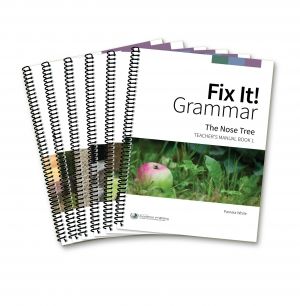
Fix It! Grammar is a unique grammar program because it teaches grammar concepts through real stories. The stories use real sentences that contain real errors that your student might make in their own writing. Through marking up the sentences and finding errors, the student learns grammar and correct usage, with the long view that this will transfer to the student's own writing.

Each day's reading also has a vocabulary word. This word is in bold print, and the student is directed to look the word up in a dictionary, decide on the definition that best fits the sentence, and write a short definition in the vocabulary section of their notebook.
If you are looking for a non-traditional grammar program that will reinforce writing skills, definitely check out Fix It! Grammar. Click on the banner below to read reviews of books 1-5.

- Fix It! Grammar The Nose Tree [Book 1] (Teacher Manual): $19.00
- Fix It! Grammar The Nose Tree [Book 1] (Student Book): $15.00
Fix It! Grammar is designed for grades 3 and up. There are 6 books in the series:
- Fix It! Grammar: The Nose Tree
- Fix It! Grammar: Robin Hood
- Fix It! Grammar: Frog Prince, or Just Deserts
- Fix It! Grammar: Little Mermaid
- Fix It! Grammar: Chanticleer
- Fix It! Grammar: Sir Gawain and the Green Knight
The book your student would begin with would depend on their grammar knowledge. IEW has a placement test to help you determine which book your student should begin with, and I'd recommend taking a look at the test just to verify where you think your student should start.
Fix It! Grammar is a unique grammar program because it teaches grammar concepts through real stories. The stories use real sentences that contain real errors that your student might make in their own writing. Through marking up the sentences and finding errors, the student learns grammar and correct usage, with the long view that this will transfer to the student's own writing.
As mentioned above, we received Fix It! Grammar Book 1: The Nose Tree. This book, like the others in the series, is designed to be used over the course of one year. There are 33 weeks of lessons, and it should take about 15 minutes a day. We received the Teacher's Manual and the Student Book. They are both high quality, spiral bound books. With the purchase of the Teacher's Manual, you also receive access to a PDF download of the Student Book so if you prefer to print your own Student Book, this is an option.
Each student should have a notebook. If you have chosen to print your own Student Book, the notebook should have four sections: Fix Its, Grammar Glossary, Rewrite, and Vocabulary. If you purchase the Student Book, then the notebook would only have two sections: Rewrite and Vocabulary.
On the first day of each week's work, you read through the section titled "Learn It" with your student (this section contains the teaching for the week). There are grammar flash cards included in the Student Book, and your student should cut out any that are applicable to the day's lesson so they can review the concept. Next, you help your student mark up the first sentence in the reading. Once the sentence is corrected, the student copies the corrected version into the Rewrite section of their notebook. For Days 2-4, the student corrects the sentence for the day on their own, and copies the corrected version into their notebook. At the end of the program, the student will have a clean, corrected version of the story.
Each day's reading also has a vocabulary word. This word is in bold print, and the student is directed to look the word up in a dictionary, decide on the definition that best fits the sentence, and write a short definition in the vocabulary section of their notebook.
I used this with Luke & Ezekiel, and I started them in Book 1 to help them learn to recognize errors in writing. I used the method described above, though I did not always read through day 1 with them and help them correct the first sentence. Since they were already familiar with the grammar ideas, they did okay without my help, but this would not have worked if they were brand new to grammar. I love that they are learning to find errors in real writing, since this can be difficult to teach using a traditional grammar program. I loved that they were copying a real story as part of the program. The vocabulary was the weakest part of the program, but I think this has to do with the fact Luke & Ezekiel are in 9th & 8th grades. If I had chosen to use this with my 3rd grader, the minimum recommended age, I would definitely have had to spend time with him every day walking him through the sentences and he would have gotten more out of the vocabulary portion.
If you are looking for a non-traditional grammar program that will reinforce writing skills, definitely check out Fix It! Grammar. Click on the banner below to read reviews of books 1-5.
Saturday, September 20, 2014
Trucking Along
This is the slowest start we've ever had to a school year. We still have 1 or 2 subjects to start, but overall it's going well. The biggest issue is the driving. I've gone from driving 50-75 miles/week, to driving around 300. Some of these are longer drives, some are shorter. But I feel like I'm constantly stopping what I'm doing to get a boy somewhere or pick a boy up. It's not even that each boy has too many outside activities, it's just that they aren't all doing the same thing on the same day anymore.
It's worth it, though. The younger three are learning some fun stuff in their enrichment program, and to quote Luke "I'm in love with my engineering class". Can't argue with that!
It's worth it, though. The younger three are learning some fun stuff in their enrichment program, and to quote Luke "I'm in love with my engineering class". Can't argue with that!
Wednesday, September 10, 2014
Review: Under Drake's Flag
A handful of weeks ago, we were given the opportunity to review Under Drake's Flag, produced by Heirloom Audio Productions. This 2 CD set with an abridged study guide sells for $29.95, and is most suitable for ages 6 through adult.
We really enjoy listening to audio books here at Larson Boys Academy, especially when we're all in the van together. Now that the boys are older, it seems that we're running in different directions quite often so we don't get to listen to as many as we used to. However, this CD set arrived just before we left on a road trip to visit family so the timing was perfect for all 7 of us to listen to the story.
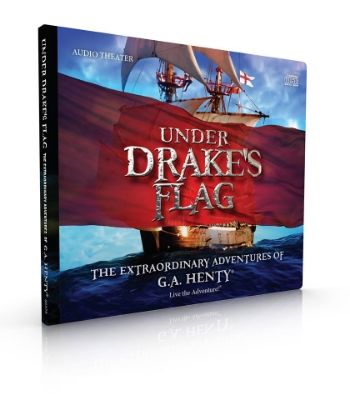
This is a 2 hour long audio theater production of G.A. Henty's story about Sir Francis Drake. Since it is an audio theater production, it's more than just a narrator reading the story. There is a full cast of talented actors performing the story, along with sound effects and a musical score that make the story come alive.
Sir Francis Drake lived from 1540-1596. He circumnavigated the globe for England, helped defeat the Spanish Armada when they invaded trying to capture England, and was made a knight by Queen Elizabeth. More importantly, he was a strong Christian and his Christian values guided what he did.
This story tells about Sir Francis Drake and his adventures through the experiences of Ned Hawkshaw. During Ned's travels, he experiences battles, a shipwreck, and even a shark attack, and then he witnesses the Spanish Inquisition.
This story tells about Sir Francis Drake and his adventures through the experiences of Ned Hawkshaw. During Ned's travels, he experiences battles, a shipwreck, and even a shark attack, and then he witnesses the Spanish Inquisition.
Included with the CDs is an abridged study guide. This abridged guide is divided into 19 sections, and each section has three parts: "Listening Well" (comprehension questions), "Thinking Further" (questions that require your child to use critical thought to think more deeply about the story), and "Defining Words" (words that your child might need to look up in order to understand a bit more about the story). There are also 3 short Bible studies in the back of the guide.
There is also a full study guide available as a PDF download. This full study guide has the same sections as the abridged version, but there are a more questions and words listed. For example, in the first section, the abridged guide has 3 "Listening Well" questions, 3 "Thinking Further" questions, and 2 words under "Defining Words". The full study guide has 8 "Listening Well" questions, 9 "Thinking Further" questions, and 6 words under "Defining Words".
There is also a full study guide available as a PDF download. This full study guide has the same sections as the abridged version, but there are a more questions and words listed. For example, in the first section, the abridged guide has 3 "Listening Well" questions, 3 "Thinking Further" questions, and 2 words under "Defining Words". The full study guide has 8 "Listening Well" questions, 9 "Thinking Further" questions, and 6 words under "Defining Words".
This audio drama is very well done. It was enjoyed by all 7 of us on our road trip. The cast did a superb job, and the musical score and sound effects transported us into the story so we felt as if we were on the high seas ourselves, even though we were actually travelling through the midwest.
Since we enjoyed Under Drake's Flag so much, I was excited to hear that Heirloom Audio Productions is currently working on a second title: In Freedom's Cause. This GA Henty book is about William Wallace and Robert the Bruce, and the projected release date is November.
Saturday, September 06, 2014
Thought From the 8 Year Old
Me: "What are you thinking about?"
Nicholas: "I know what I'm going to say if I ever lose a limb."
Me: "What?"
Nicholas: "'Tis a mere flesh wound."
Okay, then.
Nicholas: "I know what I'm going to say if I ever lose a limb."
Me: "What?"
Nicholas: "'Tis a mere flesh wound."
Okay, then.
Saturday, August 30, 2014
Good Point
"Mom, you've known me longer than anyone. Even longer than I've known myself, because when I was born, I didn't know who I was.". --Micah
Saturday, August 23, 2014
We Haven't Even Started!
We've got a slow start going here, and yet the wisecrackery is already beginning.
I just happened to scan one of Ezekiel's assignments using literary devices.
I don't know the question, but his answer was: "School is so boring, I died. I cannot complete this assignment."
I just happened to scan one of Ezekiel's assignments using literary devices.
I don't know the question, but his answer was: "School is so boring, I died. I cannot complete this assignment."
Saturday, August 16, 2014
A Sweet Bouquet
Jacob & Nicholas picked this for me last week. Flowers from the backyard, lovingly tied up into a very sweet bouquet.


Monday, August 11, 2014
A Little Delay....
We were supposed to start today.
It's not going to happen.
I'm currently shooting for an August 25 start date, though September 2 might have to do.
It's not going to happen.
I'm currently shooting for an August 25 start date, though September 2 might have to do.
Monday, August 04, 2014
Review: Old Western Culture-The Greeks
Every now and then a product comes along that really, really excites me. Roman Roads Media has released one of these products: Old Western Culture: The Greeks. The subtitle to this DVD course is "A Christian Approach to Great Books".
That's right--I said a DVD course that is a Christian approach to Great Books. Now maybe you understand my excitement!
 Now that I've described what it is, how does it work? Luke and Ezekiel both fall in the suggested age range, and we began with the first unit, The Epics. In this unit, your student will read both The Iliad and The Odyssey. This unit has a schedule available for download on the Roman Roads website, while the other units have a schedule printed in the included Art Guide. This schedule shows a recommended nine week schedule, working 5 days a week. We followed this schedule pretty closely (we began with The Epics unit), though since it is summer we didn't always work 5 days a week.
The first lecture of each unit is an introduction to the topic of the unit. After watching the introduction, there are study questions in the student workbook for the student to answer. An important point to note is that on each DVD there is a link on the menu for the study questions. If your student has any trouble answering the questions, they can simply go to the study question link, find the appropriate question, and re-watch the pertinent portion of the DVD lecture.
After the introductory lesson, the student then begins to read the books for the unit. Some days the student simply reads; other days the student will answer questions in the workbook about their reading; other days they will watch a video lecture about what they are reading and will answer questions in the workbook about the lectures.
The student is asked to write one paper for each unit. According to the recommended schedule, they should take about 3 weeks to write the paper. It is suggested that the paper be about 750-1200 words long. In each workbook, there are several discussion questions, and if your student is struggling to come up with a thesis statement, they can use the discussion questions as a starting point for their paper.
Each unit also has a final exam. These are available on the Roman Roads website. If your student doesn't make a satisfactory grade on the exam, Roman Roads provides an exam B on the website as well.
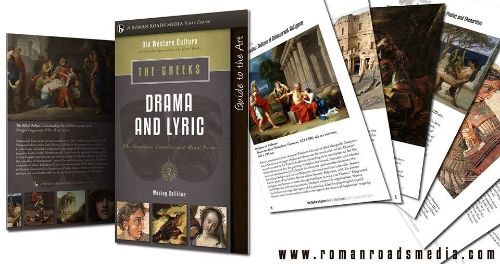
I mentioned above that there is a "Guide to the Art" booklet included, and that the DVDs have wonderful artwork. Throughout the lectures, related artwork is shown on the screen. The "Guide to the Art" booklet contains full color reproductions of all this artwork, along with the title, artist, and information about the artwork and/or artist, meaning there is a mini art history course included as well.

Luke and Ezekiel are both very good readers, however Luke tends to be a slower reader. The amount of reading is stretching Luke (in a good way), and having the suggested schedule helps me to see what a reasonable amount of reading is for a typical student. We have found that following the schedule means that we're working on this 60-90+ minutes a day. I think this is a fabulous use of our time, though, considering all that we are learning.
I appreciate that the program approaches these Great Books from a Christian perspective. It is recognized that even though the authors were not believers, they still had worthwhile thoughts and ideas and is not afraid to tackle these head on, using a Christian worldview.
We're all enjoying this program, and we're all learning so much. This program has made doing a Great Books study possible for our family; not only has it made it possible, it has made it possible to do it well and I am so excited about continuing with the next 3 years (The Romans, Christendom, and Early Moderns) of Old Western Culture.
That's right--I said a DVD course that is a Christian approach to Great Books. Now maybe you understand my excitement!
Way back when I was just starting our homeschool journey with Luke, I knew I wanted to give my sons an education using the Great Books as they entered Junior High & High School. As time went on I never waivered in this goal, but our family ended up consisting of five closely spaced sons, I ended up with a chronic autoimmune liver disease, and last December I felt like God was nudging me to take a part time job at our church. Combine these circumstances with the fact I did not receive the kind of education I wanted to give my boys, and I was struggling to provide what I'd hoped to.
Enter Wesley Callihan & Roman Roads Media.
Enter Wesley Callihan & Roman Roads Media.
Wes Callihan is the highly qualified teacher on The Greeks DVDs. He has a degree in history, has taught in many classrooms, has written Great Books study guides for Veritas Press, speaks at homeschool conferences, and is founder of Schola Classical Tutorials. All this to say, he is passionate about the subject matter he teaches. His love of the Great Books shines through, and he's a wonderful teacher.
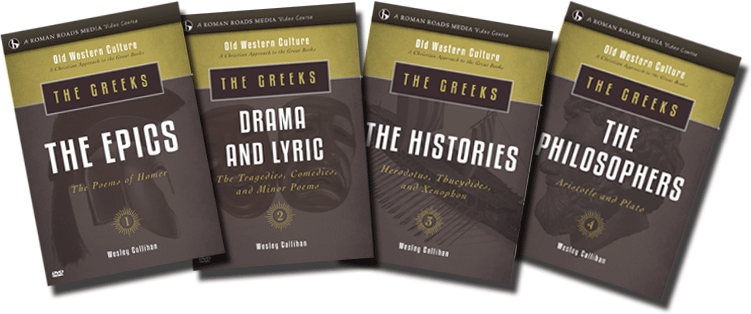
What exactly is Old Western Culture: The Greeks? It is a four part DVD series that is a complete literature and social studies course for students in grades 8 and up. This program was created for homeschoolers, so it is extremely homeschool friendly. Each unit has 12 video lessons that are about 30 minutes each, for a total of 48 video lessons. These video lessons aren't boring lectures, either. As mentioned above, Wes Callihan is an engaging teacher who loves and knows the subject matter, and the lessons are full of wonderful graphics and artwork.
Each of the following four units can also be used as a stand alone unit, and as such, they can be used in any order:
Each of the following four units can also be used as a stand alone unit, and as such, they can be used in any order:
- The Epics: The Poems of Homer
- Drama and Lyric: The Tragedies, Comedies, and Minor Poems
- The Histories: Herodotus, Thucydides, and Xenophon
- The Philosophers: The Works of Plato and Aristotle
If you do all four units, your child will read Homer, Plato, Aristotle, Herodotus, Thucydides, Sophocles, and more throughout the year.
In addition to the instruction, each part contains a PDF workbook, a Teacher's Edition, and needed texts in PDF format. There is also an exam for each part, and writing assignments for your student. Each DVD unit also contains a "Guide to the Art" booklet. For $224, you have access to all that you need for the year. Roman Roads does suggest that you purchase physical copies of the books read throughout the course, but if you choose not to, everything you need is included.
You can also purchase copies of the workbook if you'd rather not print them. I received a hardcopy of The Histories workbook. It is a spiral bound black and white workbook (with a color cover), and the answers are in the back of the workbook. I have a black and white laser printer, and for our family I see no benefit in ordering a pre-printed workbook. However, if you choose to do so, this is a quality product.
You can also purchase copies of the workbook if you'd rather not print them. I received a hardcopy of The Histories workbook. It is a spiral bound black and white workbook (with a color cover), and the answers are in the back of the workbook. I have a black and white laser printer, and for our family I see no benefit in ordering a pre-printed workbook. However, if you choose to do so, this is a quality product.
The first lecture of each unit is an introduction to the topic of the unit. After watching the introduction, there are study questions in the student workbook for the student to answer. An important point to note is that on each DVD there is a link on the menu for the study questions. If your student has any trouble answering the questions, they can simply go to the study question link, find the appropriate question, and re-watch the pertinent portion of the DVD lecture.
After the introductory lesson, the student then begins to read the books for the unit. Some days the student simply reads; other days the student will answer questions in the workbook about their reading; other days they will watch a video lecture about what they are reading and will answer questions in the workbook about the lectures.
The student is asked to write one paper for each unit. According to the recommended schedule, they should take about 3 weeks to write the paper. It is suggested that the paper be about 750-1200 words long. In each workbook, there are several discussion questions, and if your student is struggling to come up with a thesis statement, they can use the discussion questions as a starting point for their paper.
Each unit also has a final exam. These are available on the Roman Roads website. If your student doesn't make a satisfactory grade on the exam, Roman Roads provides an exam B on the website as well.
I mentioned above that there is a "Guide to the Art" booklet included, and that the DVDs have wonderful artwork. Throughout the lectures, related artwork is shown on the screen. The "Guide to the Art" booklet contains full color reproductions of all this artwork, along with the title, artist, and information about the artwork and/or artist, meaning there is a mini art history course included as well.
Two years ago, Luke, Ezekiel, and I studied the ancients. We were supposed to read The Odyssey, but I was intimidated. It is not a skinny book, and it's not written in a style that I'm comfortable with. This meant I was unsure how to approach this book with them, so we skipped it. However, now that we're going through The Iliad with Wes Callihan, I look forward to tackling The Odyssey next with the boys.
While you could turn your student loose with the DVDs and reading, the parent is encouraged to watch the lectures and have discussions with their child. I like that following this model, we are all learning together. During one of our first discussions using the discussion questions in the workbook, the boys assumed I had the answers in my notebook. The discussion questions do not have answers in the Teacher Edition, which meant (as I had to explain to them) that I was having to use my brain to think about and discover answers alongside them.
While you could turn your student loose with the DVDs and reading, the parent is encouraged to watch the lectures and have discussions with their child. I like that following this model, we are all learning together. During one of our first discussions using the discussion questions in the workbook, the boys assumed I had the answers in my notebook. The discussion questions do not have answers in the Teacher Edition, which meant (as I had to explain to them) that I was having to use my brain to think about and discover answers alongside them.
Luke and Ezekiel are both very good readers, however Luke tends to be a slower reader. The amount of reading is stretching Luke (in a good way), and having the suggested schedule helps me to see what a reasonable amount of reading is for a typical student. We have found that following the schedule means that we're working on this 60-90+ minutes a day. I think this is a fabulous use of our time, though, considering all that we are learning.
I appreciate that the program approaches these Great Books from a Christian perspective. It is recognized that even though the authors were not believers, they still had worthwhile thoughts and ideas and is not afraid to tackle these head on, using a Christian worldview.
We're all enjoying this program, and we're all learning so much. This program has made doing a Great Books study possible for our family; not only has it made it possible, it has made it possible to do it well and I am so excited about continuing with the next 3 years (The Romans, Christendom, and Early Moderns) of Old Western Culture.
Thursday, July 31, 2014
2014/2105 School Year
I can't believe another year is about to start. I still don't have all the decisions made, and I'm not close to being ready, but I am making slow progress. We've begun some things slowly, and will start full force August 18. Here's most of the lineup.
Luke:
The Greeks (Roman Roads Media)
Spielvogel's Western Civilization (relevant portions, along with the study guide)
Saxon Algebra 2
Vocabulary for the High School Student
English Grammar Revolution
Writing with Skill 1
Rhetorical Devices
Discovery of Deduction
Derek Owen's Physical Science
Lingua Latina (online class through Compass Classroom)
Introduction to Engineering Design (he'll be taking this at the high school)
Drums, piano, robotics, and recreational tumbling/trampoline gymnastics
Ezekiel:
The Greeks (Roman Roads Media)
Spielvogel's Western Civilization (relevant portions, along with the study guide)
Saxon Algebra 1
Rod & Staff Spelling
English Grammar Revolution
Writing with Skill 1
Rhetorical Devices
Discovery of Deduction
Derek Owen's Physical Science
Lingua Latina (online class through Compass Classroom)
Piano, robotics, recreational tumbling/trampoline gymnastics, and team t&t gymnastics
Jacob:
Winter Promise Quest for the Middle Ages
The Human Odyssey (relevant portions)
ctcmath.com/Learn Math Fast/Mathematical Reasoning
Rod & Staff Spelling
Hake Grammar 7
Writing with Skill 1
Figuratively Speaking
Lightning Literature and Composition 7
Building Thinking Skills
Holt Earth Science
Getting Started with Latin/Visual Latin
Enrichment program, piano, and recreational tumbling/trampoline gymnastics
Micah:
Winter Promise Quest for the Middle Ages
The Human Odyssey (relevant portions)
ctcmath.com/Learn Math Fast/Mathematical Reasoning
Rod & Staff Spelling
Hake Grammar 5
Classical Academic Press Writing & Rhetoric 1 & 2
Mom's Reading List
Building Thinking Skills
Houghton Mifflin Science 6
Enrichment program, piano, and recreational tumbling/trampoline gymnastics
Nicholas:
Winter Promise Quest for the Middle Ages
Story of the World 2
ctcmath.com/Learn Math Fast/Mathematical Reasoning
Rod & Staff Spelling
Hake Grammar 4
Classical Academic Press Writing & Rhetoric 1 & 2
Mom's Reading List
Building Thinking Skills
Houghton Mifflin Science 4
Enrichment program, piano, and recreational tumbling/trampoline gymnastics
Luke:
The Greeks (Roman Roads Media)
Spielvogel's Western Civilization (relevant portions, along with the study guide)
Saxon Algebra 2
Vocabulary for the High School Student
English Grammar Revolution
Writing with Skill 1
Rhetorical Devices
Discovery of Deduction
Derek Owen's Physical Science
Lingua Latina (online class through Compass Classroom)
Introduction to Engineering Design (he'll be taking this at the high school)
Drums, piano, robotics, and recreational tumbling/trampoline gymnastics
Ezekiel:
The Greeks (Roman Roads Media)
Spielvogel's Western Civilization (relevant portions, along with the study guide)
Saxon Algebra 1
Rod & Staff Spelling
English Grammar Revolution
Writing with Skill 1
Rhetorical Devices
Discovery of Deduction
Derek Owen's Physical Science
Lingua Latina (online class through Compass Classroom)
Piano, robotics, recreational tumbling/trampoline gymnastics, and team t&t gymnastics
Jacob:
Winter Promise Quest for the Middle Ages
The Human Odyssey (relevant portions)
ctcmath.com/Learn Math Fast/Mathematical Reasoning
Rod & Staff Spelling
Hake Grammar 7
Writing with Skill 1
Figuratively Speaking
Lightning Literature and Composition 7
Building Thinking Skills
Holt Earth Science
Getting Started with Latin/Visual Latin
Enrichment program, piano, and recreational tumbling/trampoline gymnastics
Micah:
Winter Promise Quest for the Middle Ages
The Human Odyssey (relevant portions)
ctcmath.com/Learn Math Fast/Mathematical Reasoning
Rod & Staff Spelling
Hake Grammar 5
Classical Academic Press Writing & Rhetoric 1 & 2
Mom's Reading List
Building Thinking Skills
Houghton Mifflin Science 6
Enrichment program, piano, and recreational tumbling/trampoline gymnastics
Nicholas:
Winter Promise Quest for the Middle Ages
Story of the World 2
ctcmath.com/Learn Math Fast/Mathematical Reasoning
Rod & Staff Spelling
Hake Grammar 4
Classical Academic Press Writing & Rhetoric 1 & 2
Mom's Reading List
Building Thinking Skills
Houghton Mifflin Science 4
Enrichment program, piano, and recreational tumbling/trampoline gymnastics
Wednesday, July 30, 2014
Review: Lightning Literature & Composition Grade 7
The opportunity to review Lightning Literature and Composition from Hewitt Homeschooling could not have come at a better time. I was in the midst of figuring out what I would do for literature for Jacob's 7th grade year. Needless to say, I was quite excited when I received the following items:

The Teacher's Guide contains a planning guide, and this guide breaks the program down into 36 weeks. The plans aren't broken down into daily assignments, but this allows for a lot of flexibility for your student. There are answers for all of the comprehension questions in the student book, as well as teaching helps for each of the lessons and writing assignments. Also included are discussion questions and answers for the student workbook.
This program is not easy for Jacob, but he feels that he is learning and he likes it. He likes that the Student Guide is written directly to him, and he feels that it is doing a good job teaching him. He also likes that the worksheets make him think, and he was happy that he was able to pick a writing assignment that interested him.
I like that the Teacher's Guide takes the time to explain what I need to look for in an answer, and also points out that Jacob might find certain aspects of assignments difficult, and that it's okay if he does. I feel like instead of being just an answer key, it's helps to develop me as a teacher.
Looking forward to future lessons, I'm excited about finishing this program with Jacob this year. I'd recommend that you check out the other offerings from Hewitt Homeschooling. Lightning Literature and Composition Grade is perfect for grades 7-8. Other levels of their Lightning Literature & Composition were reviewed by other bloggers on the Crew; click on the banner below to read their opinions!

- Lightning Literature and Composition: Grade 7 Student's Guide ($20)
- Lightning Literature and Composition: Grade 7 Student's Workbook ($20)
- Lightning Literature and Composition: Grade 7 Teacher's Guide ($20)
In this course, your student will read the following books (not excerpts):
- Stories & Poems for Extremely Intelligent Children of All Ages (selections)
- The Adventures of Tom Sawyer
- Alice's Adventures in Wonderland
- The Story of My Life
- All Creatures Great and Small
The Student's Guide contains the lessons written to the student. There is an introduction, and this tells the student some history about what they'll be reading, and what they should be on the lookout for while they read. After they read the introduction in the Student's Guide, the student then reads the book (or short story or poetry selection(s) ). There is a list of vocabulary words the student might need for each chapter in the book they're reading, as well as 1-2 comprehension questions for every chapter. Once the student finishes the book, they read the rest of the lesson in the Student's Guide. There is a different literary lesson for each of the eight chapters:
- "Plot Line"
- "Plot Line in a Novel"
- "Introduction to Poetry & Rhyme"
- "Creativity"
- "Dialogue"
- "Autobiography"
- "Sound in Poetry"
- "The Character Sketch"
Also included in each chapter in the student book is a mini lesson, and these mini-lessons focus on composition:
- "Another Opening"
- "Outlines"
- "Limerick and Haiku"
- "Nonce Words"
- "Saying it with Style"
- "Brainstorming"
- "Cinquain and List Poem"
- "Choosing a Topic"
The Student's Workbook has worksheets for each chapter, and they are to be completed after the student reads the literature and the lesson in the Student's Guide. The student uses what they learn through reading to complete the worksheets. These worksheets are not easy, but cause the student to really apply what they're learning, often times by using excerpts from other good literature. They practice different skills like writing couplets (and other poetry forms), they are asked to correctly punctuate and capitalize a short story that uses a lot of dialogue, they have to identify fact and opinions in writing, they analyze writing to find the topic sentences and supporting sentences, and more. There is one crossword puzzle and one word search for each chapter.
We are loving Lightning Literature & Composition. We are following the planning guide that is included, and moving at a pace that is comfortable for Jacob. He's a strong reader, and we finished the first chapter, and he's well into reading Tom Sawyer. I love that the program is based on reading real, good, unabridged books.
This program is not easy for Jacob, but he feels that he is learning and he likes it. He likes that the Student Guide is written directly to him, and he feels that it is doing a good job teaching him. He also likes that the worksheets make him think, and he was happy that he was able to pick a writing assignment that interested him.
I like that the Teacher's Guide takes the time to explain what I need to look for in an answer, and also points out that Jacob might find certain aspects of assignments difficult, and that it's okay if he does. I feel like instead of being just an answer key, it's helps to develop me as a teacher.
Looking forward to future lessons, I'm excited about finishing this program with Jacob this year. I'd recommend that you check out the other offerings from Hewitt Homeschooling. Lightning Literature and Composition Grade is perfect for grades 7-8. Other levels of their Lightning Literature & Composition were reviewed by other bloggers on the Crew; click on the banner below to read their opinions!
|
Monday, July 28, 2014
Review: Beyond the Book Report
We recently had the opportunity to review a new product from Analytical Grammar called Beyond the Book Report. As suggested by the title, this program is designed to help teach or improve your middle grade student's writing.
There are three seasons in this program, and they can be used alone or in conjunction with the Analytical Grammar program. Each season costs $24.95, or you can purchase a bundle that includes all three for $69.95. Seasons 1 & 2 are recommended for grades 6-8, while Season 3 is for slightly older children (grades 8-10). You can view different recommended schedules, depending on what grade you start the program in.
Season 1 teaches:
- Basic Book Report: In this unit, your child will focus on paraphrasing and summarizing. They'll also learn about conflict, point of view, climax, and protagonist/antagonist
- Pamphlet Book Report: Your child will produce a book report in pamphlet form in this unit. They'll be introduced to plot elements, mood and tone, setting, and genre.
- News Article Book Report: Your child will write a news article about their favorite scene in a book they chose, and then they'll have to rewrite the article from the opposite bias. Since they're learning to write a news article, they'll learn about various concepts related to news articles (bylines, headlines, etc.), as well as bias and objectivity.
Season 2 teaches:
- Poetry Book Report: Your student will write a limerick, haiku, sonnet, and narrative poem based on the book they read. They'll also study metaphors, alliteration, personification, and other figures of speech.
- Drama Book Report: In this unit, your student will dramatize their favorite scene. They'll be introduced to different genres (such as comedy and melodrama) and different terms (monologue, dialogue, and more).
Season 3 teaches:
- Essay: This unit breaks writing an essay (personal, literary, and SAT) down into easy steps.
- Oral Report: Your student will learn how to dive an oral report with a power point presentation.
- Research Paper: This unit teaches your student how to write a research paper through easy steps.
Each Season comes shrink wrapped with a teacher packet and DVD. The teacher packets contain a hardcopy of the different scheduling options, a teaching guide, answer keys, examples, and reference pages. The DVDs contain lectures, as well as printable student materials and rubrics in PDF format.
Beyond the Book Report can be used with any book you or your child chooses. They do encourage reading good books, preferably classics, but any book will do. By not being tied to a booklist the authors thought up, you are able to tailor this program to what your child is interested in or to what you're already reading for school.
The teaching is broken down into different teaching days. These teaching days don't happen one right after the other, but instead are spread out over the unit. The amount of time a unit takes will depend on your student and the books they choose to write about.
For example, in the Basic Book Report unit in Season 1, there are four teaching days. On the first day, you will watch the introductory video on the DVD, talk about potential books for the student to read for the unit, and watch a video on summary vs. paraphrase. On the second day, you'll watch a video on literary terms, and a video that contains the instructions for the Basic Book Report. On the third day, your student will submit their book choice to you, and it is assigned. Then there will be a gap while the student completes the book and assignments before the fourth teaching day. On this day, the student will turn in their report and you will evaluate the report (with your student) according to the enclosed rubric. While the number of teaching days vary according to the season and unit, they are all flexible and the amount of time it takes to complete a unit will not be the same for every student.
Note taking is also introduced through this program. There are PDFs for you to print out that have small versions of the teaching slides on the DVD lessons, with lines next to the slides. Your student is encouraged to take notes during the lecture.
Jacob and I spent time on Season 1, spending about 30 minutes 3 days a week. We would watch the DVD lecture if there was one, and then we would discuss what we had watched and any assignment that he was supposed to do. We went over how to use the reading log, which he then kept up with, and we worked on paraphrasing and summarizing. We spent a lot of time on paraphrasing as it is taught in this program.
There were pros and cons to this program. I liked that it can be used with any number of students by printing out any PDFs needed for your children. I liked that there were teaching DVDs, but both Jacob and I were distracted by the quality (they appear to have been filmed at a dining room table, and if this isn't the case they do not have a "professional" feel to them). I loved that there were rubrics for each assignment, but some of the requirements for the rubric seemed better suited for a classroom setting (and you're told not to deviate from the rubric). For example, the student gets 5 points for having the teacher physically sign off on their book choice. Another portion had the student write either study questions or a crossword puzzle for their book, and this was worth 20 points. However, I did like the easy instructions for grading the actual writing assignments that were included with the rubric.
Overall, though, this wasn't a great fit for our family. However, just because it wasn't a great fit for ours, doesn't mean it won't be a great fit for yours. Click on the Schoolhouse Review Crew banner below to read more reviews about Beyond the Book Report.
The teaching is broken down into different teaching days. These teaching days don't happen one right after the other, but instead are spread out over the unit. The amount of time a unit takes will depend on your student and the books they choose to write about.
For example, in the Basic Book Report unit in Season 1, there are four teaching days. On the first day, you will watch the introductory video on the DVD, talk about potential books for the student to read for the unit, and watch a video on summary vs. paraphrase. On the second day, you'll watch a video on literary terms, and a video that contains the instructions for the Basic Book Report. On the third day, your student will submit their book choice to you, and it is assigned. Then there will be a gap while the student completes the book and assignments before the fourth teaching day. On this day, the student will turn in their report and you will evaluate the report (with your student) according to the enclosed rubric. While the number of teaching days vary according to the season and unit, they are all flexible and the amount of time it takes to complete a unit will not be the same for every student.
Note taking is also introduced through this program. There are PDFs for you to print out that have small versions of the teaching slides on the DVD lessons, with lines next to the slides. Your student is encouraged to take notes during the lecture.
Jacob and I spent time on Season 1, spending about 30 minutes 3 days a week. We would watch the DVD lecture if there was one, and then we would discuss what we had watched and any assignment that he was supposed to do. We went over how to use the reading log, which he then kept up with, and we worked on paraphrasing and summarizing. We spent a lot of time on paraphrasing as it is taught in this program.
There were pros and cons to this program. I liked that it can be used with any number of students by printing out any PDFs needed for your children. I liked that there were teaching DVDs, but both Jacob and I were distracted by the quality (they appear to have been filmed at a dining room table, and if this isn't the case they do not have a "professional" feel to them). I loved that there were rubrics for each assignment, but some of the requirements for the rubric seemed better suited for a classroom setting (and you're told not to deviate from the rubric). For example, the student gets 5 points for having the teacher physically sign off on their book choice. Another portion had the student write either study questions or a crossword puzzle for their book, and this was worth 20 points. However, I did like the easy instructions for grading the actual writing assignments that were included with the rubric.
Overall, though, this wasn't a great fit for our family. However, just because it wasn't a great fit for ours, doesn't mean it won't be a great fit for yours. Click on the Schoolhouse Review Crew banner below to read more reviews about Beyond the Book Report.
Saturday, July 26, 2014
Perspective
"Why are we celebrating that Luke is one year closer to death?" -Micah, when he wasn't pleased with the birthday activity Luke chose
Sunday, July 20, 2014
Review: HomeSchoolPiano
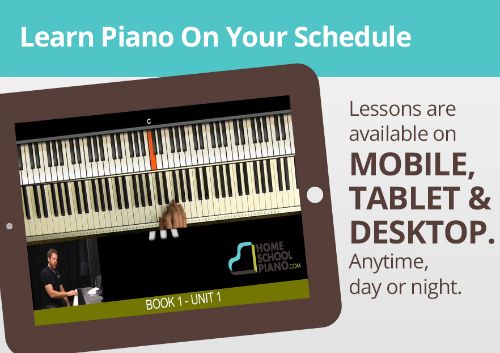
HomeSchoolPiano, which provides online piano lessons with teacher Willie Myette, recently gave us the opportunity to review their HomeSchoolPiano - Complete Set of Books. We were given a lifetime subscription for up five students, which obviously worked out perfectly for our family.
Have you ever wished that your children could learn to play the piano? Have you struggled finding a piano teacher, or struggled with finding the time to run your children to lessons, or faced another barrier to providing piano lessons for your children?
HomeSchoolPiano might just be the answer for you. This program is for all ages, and lessons are accessible any time that suits you. All you need is:
- A piano or keyboard (with at least 49 full size keys)
- A tablet (any tablet, or even a smartphone) or computer with an internet connection
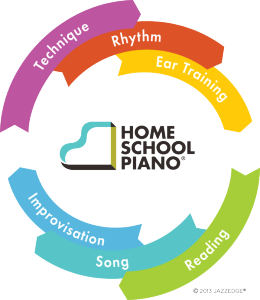
HomeSchoolPiano follows a six step method to teach piano to your child.
- Technique
- Rhythm
- Ear Training
- Reading
- Song
- Improvisation
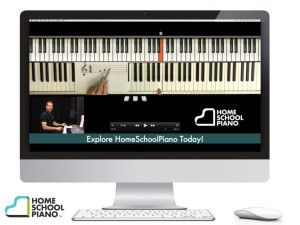
There are 3 different levels (books) and beginner Core lessons, with PDF books to print for each level. I printed out all of levels, and spiral bound them. You could easily use a binder as well. These workbooks contain music for the student to play, along with scales to practice, pages to practice rhythms, and empty music staffs to write down the music created during improvisation. All of the workbook pages are labeled with the unit and lesson that they correspond to.
I had each of the boys figure out which level they should start at, because they've all had piano lessons (anywhere from 1 to 10 years, depending on the boy). I don't play the piano, so I figured they could figure this out more easily than I could. Then they just worked through the lessons a few times a week. The boys used the iPad to watch the lessons and take the quizzes.
I love this online program. I love that the boys are learning technique, correct form, sight reading, as well as improvisation. We view learning to play music as an important part of the boys' education, and even though they aren't beginners, HomeSchoolPiano is very beneficial for them. The boys don't always love piano, but they like this program. The most difficult thing about this is making sure they practice, but that's always been the case. Willie is a good teacher, and it's nice that we're able to do lessons on our schedule. Having the ability to check their progress from anywhere is very beneficial. I just found out our piano teacher is taking the semester off from teaching, so instead of looking for a new teacher, we will continue with HomeSchoolPiano lessons. It sure is convenient!
There are two different options for purchasing the HomeSchoolPiano program, both of which provide unlimited, life-time access for up to five students.
- One payment of $299
- Payment plan: 3 monthly payments of $99.97/month

Still aren't sure if HomeSchoolPiano will work for you? You can sign up for a free lesson on the website.
It's That Time Again

I'm not sure I have everything we need, but I started writing lesson plans this weekend. I'm a visual person, I think, and work best when I can stack books in different piles according to subject.
I worked all day yesterday and really thought I'd be farther along than I am, but will keep plugging away today.
Saturday, July 12, 2014
Planning & Printing
I'm making a bit of progress on plans for this coming year. This is good news, because we need to start! Activities start up in a month, and I'd like to get into a routine with the subjects we're doing at home before the craziness of the year starts.
So I'm spending a crazy Saturday night planning courses and printing assignments.
So I'm spending a crazy Saturday night planning courses and printing assignments.
Monday, July 07, 2014
It Was a Happy 4th!
We had a lovely 4th of July. We spent the day working together as a family, putting up the boys' new trampoline. Our old one was 12ft and over the last couple of weeks the boys walked in with springs and the canvas strip that held them to the mat, so it was definitely time to replace it. The one we got is 15ft, so there was more leveling of the ground that had to be done.
Once my part was finished, I was able to work a bit more on cleaning the school room up. I finished last night (finally). Over the last couple of weeks, I went through all the books, organized the shelves, cleaned up the closet, and cleaned out their binders. Now I'm ready to start planning for the new year.
We grilled burgers for dinner, and then stopped and got ice cream and went to the parking lot of a nearby school where we were able to watch a handful of fireworks displays. A very nice day.
Once my part was finished, I was able to work a bit more on cleaning the school room up. I finished last night (finally). Over the last couple of weeks, I went through all the books, organized the shelves, cleaned up the closet, and cleaned out their binders. Now I'm ready to start planning for the new year.
We grilled burgers for dinner, and then stopped and got ice cream and went to the parking lot of a nearby school where we were able to watch a handful of fireworks displays. A very nice day.
Subscribe to:
Comments (Atom)