Saturday, March 24, 2012

Action Alert


Action Alert is parental control software for computers.  There are two versions available:  a free downloadable version, and a paid version for $29.99.

As all parents know, the internet is full of information, both good and horrible.  Our job is to keep our kids away from the horrible stuff, but kids are usually pretty computer savvy.  Action Alert is a program that will help you protect your kids.

Action Alert provides several different safety features, including:
  • Access Control:  allows you to shut your PC down remotely 
  • Site Blocking:  blocks inappropriate sites
  • Activity Notification Alerts:  email or text when there is inappropriate activity
  • Content Filtering:  allows only safe searches
  • Activity Video Recording:  records up to 60 hours of all PC activity
  • Keystroke Logging:  logs user names and passwords
  • Time Allowance:  allows you to set daily times when the PC can be used
  • Chat and Email Logging:  logs both sides of the conversation

The Activity Video Recording takes shots of every screen that is viewed.  This information can be watched using the Action Alert Viewer, like a movie.  The Time Allowance feature enables you to set times to make the internet off limits during certain hours, or you can allow a certain number of minutes per day.

I did a search that I wouldn't want my sons doing, using a pretty obvious word.  The content was blocked and I received an email immediately with a link to shut the internet down remotely.  I clicked the link, and internet access was immediately disabled.  


Overall, this an easy to use internet protection software.  I admit, I haven't spent much time looking at internet protection software, but I can't think of anything else I would want from a program.  Take time to look the website over, and give the free version a try.


To read more reviews of Action Alert, go here.


Photobucket


Photobucket


Disclaimer:  As a member of the TOS Crew, I received this product, at no cost to me, in exchange for an honest review.  All opinions are mine.  

Saturday, March 17, 2012

Progeny Press: Across Five Aprils

Progeny Press produces literature study guides for all ages.  These guides are written from a Christian perspective, and they currently have over 100 guides available.  They are available as printed booklets, pdf documents on CD, or as a pdf document emailed directly to you.  I was emailed the pdf file for the guide for the book Across Five Aprils.

The pdf files for these guides are interactive, so the student can type their answers directly in the pdf.  Alternatively, the files can be printed if you prefer your student to write the answers.  There is a separate answer key included as well.  The guide begins with author information and then provides historical background information for the novel.  Following this information are pre-reading activities.  Progeny Press recommends the student reads the entire book before going back to study with the guide, and suggests that the student complete one or more of the pre-reading activities during this initial reading of the book.  Most guides will take 8 to 10 weeks to complete.

After the student reads the book completely, then the student begins the study guide. The Progeny Press guides are not easy, fill-in-the-blank-without-thinking guides.  The students are asked to go above and beyond simply understanding the story, and are required to really think about the story.  There are questions about the plot, but instead of simply making sure the student read the book, the questions require to think about the book and why things happened.  Students are asked to define words by using context as well as using a dictionary.  Literary terms, such as similie and  idiom are explained, and the student is asked to find examples in excerpts taken from the book.  The student is asked to look up Bible verses and explain how they relate to the book.  Because Across Five Aprils is an historical novel about the Civil War, the student is asked to look up various battles and mark them on a map, in addition to other "Connections with History" questions.  There are also optional writing assignments in the guides.  

The guide ends with an Overview.  In this section, plot, rising action, climax, conflict, and motif are explained and the student is asked to write about each of these elements in Across Five Aprils.  Once again, these questions require more than a simple regurgitation of events in the book.

I'm not a huge fan of literature study guides in general.  We read a lot of books in our homeschool and we typically just discuss them.  However, I'm impressed with the Progeny Press study guides and I am considering ordering one or two for Jacob to complete next year.  Since I now have five in school, I don't always have time to read every book that my boys read, let alone discuss every book.  The questions in the Progeny Press guide are very thorough, and I really think they can fill this gap in our homeschool.

The price for the Across Five Aprils study guide is $18.99 for the booklet, $16.99 for a CD, or $23.99 for a book/CD package.  Shipping is additional for these items, but you can have the pdf emailed to you for $16.99 to save on shipping.  If you're looking for study guides for literature, definitely take a look at the guides from Progeny Press.

For additional reviews of Progeny Press Study Guides, go here.


Photobucket


Disclaimer:  As a member of the TOS Crew, I received this product, at no cost to me, in exchange for an honest review.  All opinions are mine. 

Thursday, March 15, 2012

Falling Down

Nicholas is one of the happiest kids I've ever met.  He's always got a smile on  his face, and he laughs quite a bit.  Even tears often end with a smile or a laugh.

He went roller skating with Craig 2 weeks ago.  After they finished, he quite joyfully told Craig, "I went around 29 times and only fell 20!"  Instead of focusing on the 20 times he did fall, he was absolutely thrilled that there were 9 times he didn't fall.

I think there's a lesson for me in there somewhere.

Saturday, March 10, 2012

The Art of Argument

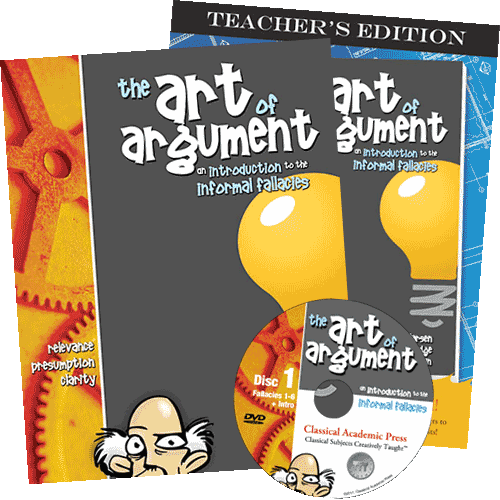
Ezekiel took one look at the book on my desk and proclaimed, "Hey, I'm great at that!"  He'd never been more correct.  What was the book?  The Art of Argument, An Introduction to the Informal Fallacies by Classical Academic Press.

I've had my eye on this program, with the intention of using it next year with Luke and Ezekiel.  If they're going to argue with me, I think we should at least follow some rules, right?  I was very excited to when the opportunity arose for me to review it.  I received the textbook, the Teacher's Edition, and the first disk from the DVD set.

There are 28 fallacies covered in this program, and they're divided into six chapters:  Ad Fontem Arguments,  Appeals to Emotion, Red Herrings, Fallacies of Presupposition, Fallacies of Induction, and Fallacies of Clarity. At the end of each chapter, there is a chapter review, along with a cumulative review worksheet (for chapters 2-6).  The six chapters are divided into 3 units (Relevance, Presumption, and Clarity), and these sections give an overview of the fallacies that will be discussed.  The Teacher's Edition includes a copy of the textbook with the answers filled in, tests and answers for each chapter, each unit, and a final exam on all the material.  There is enough material here for a full year of informal logic study.

To use this program, we read through the fallacy, watched the DVD segment (a teacher discussing the fallacy with 4 students around a table) relating to the fallacy, and then discussed the fallacy. In the text, each fallacy is explained and there are examples that the text helps you work through.  There are also advertisements (created by Classical Academic Press) that provide discussion points for the fallacy.  Most of the fallacies end with a "Fallacy Discussion", where the student is expected to point out the fallacy on their own and explain it.  There are lines provided in the text to write an answer down, but we chose to do it orally.  It took us about 30 minutes to work through the fallacy and discussion.  The DVD segments take an additional 15 to 30 minutes to watch.

We really enjoyed using The Art of Argument, and I think it's a fabulous informal logic program.  It is recommended for 7th and up, and I think that's a pretty accurate recommendation, though some 6th graders will be able to do the program just fine.  I would definitely recommend the textbook ($21.95) and the Teacher's Edition ($24.95).  The DVDs ($54.95) are not necessary, and my sons had mixed opinions about them.  Luke thought they were boring (so did I), but Ezekiel enjoyed them.  If you choose to purchase all three items, they are available bundled together for $88.95.  Check out the Classical Academic Press website for samples and ordering information.

For additional reviews of The Art of Argument, go here.


Photobucket 


  Disclaimer:  As a member of the TOS Crew, I received this product, at no cost to me, in exchange for an honest review.  All opinions are mine.

Wednesday, February 15, 2012

Valentine's Day Fire

I had a wonderful Valentine's Day.  I woke up to flowers and a lovely card from Craig, and in the evening we went out for a fabulous steak dinner. Craig gave me our traditional stuffed animal (a little stuffed pug this year) and a watch to replace one that had a damaged face due to an unfortunate accident.  A pretty perfect Valentine's Day in my world.

When we got home from dinner, there was another surprise waiting for me.  Each of the boys had drawn a little Valentine's card for me on their Kindle Fire, and they showed them to me in age order.  But when they got to Craig, Craig told me the Fire he had wouldn't work and asked me if I could take a look at it. Only Craig doesn't have a Fire.  I turned around and counted, and each boy was still holding their Fire.  I did the math and realized there was an extra Fire, and it was for me.

For much of last year, the boys were saving their money (they each get a small allowance based on age) to purchase Kindles.  When the Kindle Fire came out, we decided to surprise each of them with one for Christmas.  At some point after Christmas, the boys approached Craig and told them they wanted to buy me a Kindle Fire.  I don't know the details of how it all went down, but I do know that each of them gave a "significant amount of money according to a formula" that they came up with with Craig.  They each were willing to give enough to cover the entire cost, but thankfully, Craig put a limit on it and chipped in the rest of the money.  

Every time I look at it, I tear up.  It's not like they have jobs or like money grows on trees for them.  They each have things they would like to purchase.  Knowing that they came up with the idea on their own and were willing to sacrifice to buy me something they knew I would enjoy...well, they've blessed me more than they can understand at this point in their lives.  I am loved.

Thursday, February 09, 2012

Just a Suggestion...

"Mom, I think you should send Micah to bed for lunch with only water.  He was knocking over my stuff.  On purpose."  -Nicholas

Friday, February 03, 2012

Finders Weepers

Micah (holding up a coin):  "Mom, can I keep this?"
Me:  "Yeah, sure."
Micah:  "WooHoo!  A quarter!! 25 cents!"
Me:  "Micah, it's a nickel."
Micah:  "WooHoo!  10 cents!"
Me:  "Uh, it's 5 cents, Micah."
Micah:  "Aww, man!"

Tuesday, January 24, 2012

Our Daily Rhythm

I recently blogged a list of what we are doing in school this semester, and I've had questions about how we accomplish our work, so I thought I'd give blogging about the rhythm of our days a shot.

I have a schedule, complete with times.  It looks like this:

5:00-7:30:  My morning stuff (Bible study, exercise, completing two thoughts in a row,etc.)
7:30-8:00:  Family Bible study
8:00-8:30:  Boys dressed and fed
8:30-10:30:  Read alouds (Sonlight, science, US History)
10:30-11:30:  Math
11:30-12:00:  Grammar
12:00-1:00:  Lunch and Quiet Time
1:00-2:00:  Spelling, Phonics, Writing, Literature Discussion
2:00-2:30:  Latin
2:30-3:00:  Greek
3:00-3:30:  Logic

This is our basic daily schedule.  So far, the only problem I've had with this schedule is trying to get 6 people to follow it.  However, it does give me a framework to follow so I don't sit staring at the books and the boys and decide to take a nap because I don't know what to do.

Luke & Ezekiel are fairly independent.  They do math, Latin, Greek, and some of their writing on their own. I'm more of a discussion facilitator with them now.  Jacob is pretty independent, too, but I do directly teach him more than I do his two older brothers.  Micah and Nicholas have some things they do on their own as well.  However, lest you think they all sit down and work diligently on this independent work, I spend a lot of time saying "Get to work." or "Stop talking...whispering is still talking." or "Don't play with the dog." or "What-in-the-world-are-you-doing-will-you-just-get-to-work-before-I-lose-my-mind!".

A good day typically looks like this:

7:30-8:00:  Family Bible study (this is led by Craig)

8:00-8:45:  Say goodbye to Craig for the day, have the boys get dressed and eat.

8:45-10:15:  Read alouds in the living room (the boys usually do puzzles, draw, or work on single player logic games during this time, or play with our 6 month old puppy Jed).

10:15-10:30: When I'm done reading, I send the boys down to the schoolroom start on math (older 3) or independent work (younger 2).  I take a few minutes to recover from reading.  (This is where issues start to crop up with the schedule)

10:30-11:45:  I go down to the schoolroom and give Jacob his math lesson (he watches the DIVE cd before I go over his lesson).  Luke, Ezekiel, Jacob, and Micah all take piano, so about this time I start sending them upstairs to practice (some have to practice after lunch).  Then I pull Micah or Nicholas over to my desk and go through their work with them.  I do math, logic, and phonics with Nicholas, and math, writing, and logic with Micah.  I can usually go until 11:45 before my patience is low, so about that time I go upstairs to make lunch.

12:00-1:15:  Lunch and quiet time.  The boys take their lunch to the playroom and play quietly or watch a video (on decent days they take their lunch outside).

1:15-4:30:  I give a spelling test to Luke, Ezekiel, and Jacob, and we do a sentence from A Sentence a Day, followed by a lesson from our reading comprehension workbook.  Then we all look at the art from the Art Page a Day calendar.
I go over writing and grammar with Jacob.
I go over writing, literature discussion, and logic with Luke & Ezekiel.
I finish up with the younger two boys (whatever work is leftover from before lunch).

On Tuesdays, the boys are gone to an all day enrichment program, and on Thursday we cut it short because we have gymnastics and piano lessons in the afternoon, followed by Judo.  We have Judo on Monday as well, so we can't really run late.  It usually takes us until 4:30 to finish up, so it is a long day, but because of our outside activities, it has to be that way right now.

Like I said, this is an example of a good day.  At some point, I'll post an example of a bad day (yesterday was a bad day--we were still schooling at 8:45.  P.M.).

Hand Sanitizer?

Our before dinner family ritual is to stand in a circle, hold hands, and pray.  Anytime you get five boys together in a circle, there is bound to be some silliness which requires a bit of correction.  There are normally reminders to be quiet, reminders that we are talking to a Holy God, reminders to not squeeze each other's hands.

Sunday night, Craig said something everyone was shocked at.

"Nick, get your finger out of your nose and hold your brother's hand."

(I don't think Luke, the lucky brother next to Nick's formerly busy hand, was very thankful for that bit of correction)


Saturday, January 14, 2012

Spring, 2012

This year, the boys are in 7th, 6th, 4th, 2nd, and Kindergarten.  It's a juggling act, for sure.  Last semester was not good.  My plans were too ambitious, and we lost two mornings a week to swim lessons for 5 weeks right in the middle of the fall semester.  The lessons were very needed and well worth the time, but it was really difficult to salvage the afternoon for book work.  We never found our groove.  I reevaluated and reworked our plans the week before Christmas break.

Luke (7th):
  • Saxon Algebra 1 (with DIVE)
  • Singapore Mental Math Levels 5-6
  • Patty Paper Geometry
  • Rod & Staff English 7
  • Mosdos Silver
  • Sequential Spelling for Adults
  • Daily Warm Ups:  Reading, Grade 6
  • Sentence a Day
  • Latin Alive 1
  • Elementary Greek (finish 1, move to 2) 
  • Fallacy Detective
  • Orbiting with Logic
  • Writing With Skill
  • Classical Writing Older Beginners

Ezekiel (6th)
  • Saxon 8/7 (with DIVE)
  • Singapore Mental Math Levels 5-6
  • Patty Paper Geometry
  • Rod & Staff English 6
  • Mosdos Silver
  • Sequential Spelling for Adults
  • Daily Warm Ups:  Reading, Grade 6
  • Sentence a Day
  • Latin Alive 1
  • Elementary Greek (finish 1, move to 2)
  • Fallacy Detective
  • Orbiting with Logic
  • Writing With Skill
  • Classical Writing Older Beginners

Jacob (4th)
  • Saxon 6/5 (with DIVE)
  • Singapore Mental Math Levels 2-3
  • Patty Paper Geometry
  • Rod & Staff English 4
  • Sequential Spelling for Adults
  • Daily Warm Ups:  Reading, Grade 6
  • Sentence a Day
  • Sonlight Grade 4-5 Readers
  • Visual Latin 
  • Getting Started with Latin
  • Logic Countdown
  • Writing With Ease 4
  • Imitations in Writing (Aesop)

Micah (2nd)
  • Saxon 3
  • Singapore Mental Math Level 1
  • Kumon My Book of Telling Time
  • Rod & Staff English 2
  • Sonlight Grade 3 Readers
  • Evan-Moor Spell & Write 2
  • TV Teacher Handwriting
  • Evan-Moor Beginning Geography
  • Primary Analogies
  • Writing With Ease 2
  • Click N Kids Spelling

Nicholas (K)
  • Saxon 1
  • Kumon My Book of Easy Telling Time
  • Kumon My Book of Number Games (finish 1-70, move to 1-150)
  • Sonlight Grade 1 Readers
  • FlashKids The Complete Book of Sight Words (I teach the phonics behind the words)
  • Plaid Phonics A
  • Phonics Pathways
  • A Reason for Handwriting K (finish, move to TV Teacher Handwriting)
  • Can You Find Me? Grade K
  • K5learning.com
  • Click N Read Looney Tunes Phonics

Together
  • Sonlight Core G (finish, move to H)
  • Map Trek
  • The Story of Science (Aristotle, Newton, and Einstein)
  • Milestones in Science 
  • The Complete Book of US History
  • The American Story
  • Linguistic Development Through Poetry Memorization
  • Art a Day 2012 Calendar

Believe it or not, this is working out very well.  The only thing I'm debating is Rod & Staff English for Luke & Ezekiel--I love the program, but it might make more sense to go with Harvey's, since it's recommended for Classical Writing, and I could keep them together.  

It's hard work; I'm teaching from 8:30 until 4:30 on Wednesday and Friday.  Due to outside activities (academic enrichment program, Judo, piano, and gymnastics), we have to finish by 3:30 on Monday, the boys are gone on Tuesday, and we only have Thursday mornings at home.