Showing posts with label Logic. Show all posts

Monday, April 21, 2014

Review: Philosophy Adventure

Thinking.  Writing.  Speaking.  Biblical worldview.  These are all things I want to teach well in our homeschool.  Therefore, I was excited to get the opportunity to review Philosophy Adventure from Home School Adventure Co..
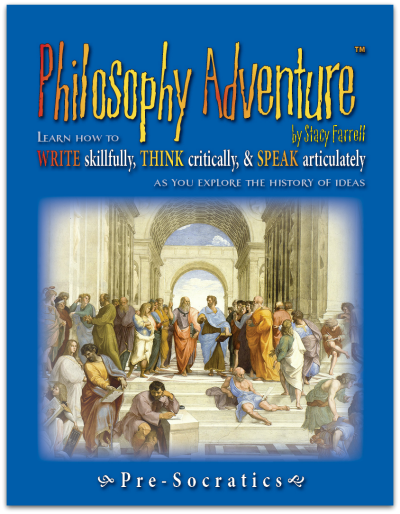


The program includes:
  • Reader
  • Student Workbook
  • Teacher's Resources
There are a few different options for purchasing, ranging from a printed and CD combo to a complete digital downloadable version.  I received the digital download version, and it is priced at $39.95.

Philosophy Adventure revolves around the Reader.  This is a lovely, full color book that contains the stories, articles, and assignments.  For example, the first lesson is on Thales (the father of Western Philosophy, and to whom the quote "Know thyself." is attributed.  It begins with explaining who Thales is and why he is important.  There is a nice sidebar that gives pertinent information, like when he lived and who his contemporaries were (Ezekiel, Buddha, and Pythagoras, are a few, if you were wondering).

There are colored coded sections within each lesson.  The first is the red "Write" section.  This contains writing assignments.  In the first lesson, the student is asked to grapple with big questions, like "Where did I come from and why am I here?".  There are no wrong answers, and the student is told to set a timer for 30 minutes.  They are instructed to read their answers aloud when finished, and to make sure they are true for what they believe today.

The second is the green "Think" section.  In this section, students read about what Thales thought.  It discusses when Thales lived, and the possibility that he was exposed to Hebrew scriptures.  In the assignment section, students are challenged to develop their memorization skills, especially for the purpose of memorizing the Bible.

The third is the brown "Speak" section.  In this section, students are exposed to more of Thales' ideas.  In the assignment for this section, students are told to answer 3 questions in their "Write Think Speak" journal.  One of these questions is "Can you identify a prize for which you would be willing to suffer?".  Again, not an easy question, but one that will truly cause the student to think.

Following the Write, Think, and Speak sections are sections that include geography, additional information on the philosophers and their contemporaries and world, and a section that includes writings by philosophers. The final section analyzes the information within the context of a Biblical worldview.

The other major portion of this course is the Student Workbook.  This workbook contains questions about the readings in the Reader, along with a map to color.  This map also includes a space to record facts learned in the Reader about each place on the map.  There is also a creative writing assignment.  For the Thales section, the student is asked to describe seeing an old man falling into a well.  The assignment gives the student several tips to help them get started, and they are instructed to set the timer for 15 minutes.  The Student Workbook also contains the "Write Think Speak" journal referenced above.  This gives the student a place to write and answer the questions in the Reader.  You have the option of printing the workbook and having your student handwrite the answers, or having your student type the answers into the workbook before printing.  In order to do the mapping assignments, you will need to print the workbook at some point.

The final portion of the program are the Teacher's Resources.  This portion includes memory cards, timeline resources (printable timelines & images), map keys, & quizzes.


While this program is designed for grades 6-12, I would be hesitant to use it with a 6th or 7th grader, and possibly some 8th graders.  I think that students who are in high school will get far more out of this program than middle school students.  Depending on how you use the program, you can award the following high school credits:


I used this with Luke (9th) and Ezekiel (8th).  There is scheduling help in the front of the Reader, so it was easy to decide how much to use every day, and the program can be used either four or five days a week.  Since I received the digital download version, I had the boys download the Student Workbook and Reader to their laptops.  They read the Reader on their computer, and I had them type their answers in the workbook.  I had technical difficulties when trying to print, so they didn't actually get the opportunity to do the map work, though they were able to answer the questions about the map.  I liked that it wasn't time intensive for me; I could tell them what to do each day and they were able to do it without assistance from me. 

The only thing I would change is the layout of the Student Workbook.  It is split into two sections--the notebook & mapwork section, and the "Think Write Speak" journal.  There are assignments for each lesson in the reader in both sections, and I think it would be so much easier to use if the assignments for each lesson were together.  Of course, you can do this yourself if you print the workbook.

I love the way Philosophy Adventure made the boys think.  I've mentioned before that I think knowing your worldview is very important, and I love the way this program had them think through what they really think.  It is a challenging program (it's easier not to think, after all), but oh, it's so very important.  Luke & Ezekiel both liked the program.  They both think it is challenging, but well worth their time, and would like to continue.


Home School Adventure Co. is offering a 10% discount on download purchases.  This discount expires May 15, 2014:



 Check out Home School Adventure Co. on:
 
 
Facebook

Twitter

Pinterest

Google+

Instagram
 
 
Click to read Crew Reviews
 
 
Crew Disclaimer

Tuesday, October 15, 2013

Review: Chess House

I don't know how to play chess.  I can never remember what all the pieces do.  Craig taught Luke & Ezekiel when they were younger, but Jacob, Micah, & Nicholas have never learned, and I lack the ability to teach them myself.  I was excited when Chess House came up for review with the Schoolhouse Review Crew. They sent the Starter Chess Learning Kit ($39.95), which is recommended for ages 4 and up.
This Starter Chess Learning Kit contains:
  • Elliot's Chess School Pawn Level (Level 1) DVD
  • Vinyl Chess Board (20" x 20")
  • Solid Plastic Chess Pieces
  • Chess Bag
I'm really impressed with the quality of the chess set and bag.  The odor free vinyl chess board is nice and large, and unrolls cleanly for a nice, smooth surface (no wrinkles or curling).  The chess pieces are sturdy, and include a regulation size king.  The bag is well constructed with pockets for the pieces, board, and DVD, and it's available in black or green.  It would be easy to throw in the car to take on the go.

National Master Elliot Neff is the teacher on Chess School DVD.  He's coached chess for over 17 years, and by watching the Chess School DVDs and practicing, you are able to learn chess from a fabulous teacher.

The Pawn Level DVD (49 minutes long) teaches:
  • Intro to Chess
  • Pawns
  • Rooks
  • Bishops
  • Queen
  • King
  • Knights
  • Castling
  • Pawn Shields
  • Development
Learning how to play chess is as easy as watching a DVD segment.  These segments are short, and the instruction by Elliot Neff is engaging and easy to understand.  After watching the DVD segment, there are practice activities for each skill taught in the booklet included in the DVD case.  These activities are fun, and really reinforce what was learned through watching Elliot on the DVD.  Skills are taught logically and sequentially, and this helps retention as well.

Jacob, Micah, & Nicholas really enjoyed Elliot's Chess School.  After mastering one skill through watching the DVD and playing the practice games, they would beg me to be able to watch the next segment on the DVD to learn the next skill.  Through watching the DVDs and practicing with each other, I saw the boys' skill levels increase.  They loved competing against each other, and I loved that they weren't just competing in a game of chance, but having to use logic and exercise their brains.  Best of all, they were having lots of fun doing it!

I firmly believe that chess is a game worthy of learning.  Strategy, logic, and memory are all taught and reinforced when playing this age-old game.  As I mentioned at the beginning of the review, I've struggled with learning chess, but this Starter Chess Learning Kit has even helped me.  If you'd like to introduce your family to the game of chess, I high recommend you check out this kit from Chess House.


 photo chess_zpsdef27258.jpg


For more reviews of Chesshouse.com, visit the Schoolhouse Review Crew.


Photobucket


 photo Disclaimer2_zpsff718028.gif

Sunday, March 24, 2013

Review: The Discovery of Deduction

About a year ago, I had the opportunity to review The Art of Argument, an informal logic program from Classical Academic Press.  Needless to say, I was very happy to have the opportunity to review their formal logic program, The Discovery of Deduction.  For this review, I was sent The Discovery of Deduction:  An Introduction to Formal Logic ($26.95) and  The Discovery of Deduction Teacher's Edition ($29.95).  This program can be used to teach formal logic to students as young as 8th grade.


PhotobucketPhotobucket


You might be wondering about the difference between formal and informal logic.  Informal logic deals with evaluating the content of an argument (fallacies such as ad hominem attacks), while formal logic deals with the form of the argument (symbols can be used to represent an argument).  The content doesn't matter; instead it's focused on the logical steps that are taken and whether they are valid or invalid.

The Discovery of Deduction can be used in a single semester or over the course of a year.  Classical Academic Press has a suggested schedule for each option.

There are four units in this program:
  • Unit I:  Introduction
  • Unit II:  Propositions and Their Relationships
  • Unit III:  Categorical Syllogisms
  • Unit IV:  Terms and Definitions


To use the program, I would have Luke and Ezekiel each read through the assigned lesson for the day (download a sample packet here). After the reading was completed, we would come together and discuss what we'd read and answer the questions.  I was thankful that I had the Teacher's Edition (download a sample packet here), because there is a lot of information to remember.  We spent 30-45 minutes on each lesson.  Like other Classical Academic Press products, The Discovery of Deduction makes formal logic as engaging as it can be made.  There are dialogues between Nate and Socrates, some humor, and some cartoon drawings.  The quality of the books are what I've come to expect from Classical Academic Press.  

While we enjoyed this program, we struggled with it.  Formal logic is very technical, and as I mentioned, there is a lot to remember.  I don't think it helped matters that Luke (8th) and Ezekiel (7th) are both on the younger side for their grades (and remember it's recommended for grades 8 & up, so Ezekiel isn't part of the recommended audience).  I knew this going into the program, but we've completed informal logic programs together without issue, so I thought we'd be able to handle this one as well.  We could continue to struggle through it, but I think we'll be best served waiting another year or two to complete this program.

That said, if you have a student who is ready for formal logic, I would definitely give this program a good, long look.  It does a great job of presenting the material, and formal logic is a great tool for training the mind.


Photobucket


For more reviews of Discovery of Deduction (and The Art of Poetry), visit the Schoolhouse Review Crew.


Photobucket


 photo Disclaimer2_zpsff718028.gif


Saturday, March 10, 2012

The Art of Argument

Ezekiel took one look at the book on my desk and proclaimed, "Hey, I'm great at that!"  He'd never been more correct.  What was the book?  The Art of Argument, An Introduction to the Informal Fallacies by Classical Academic Press.

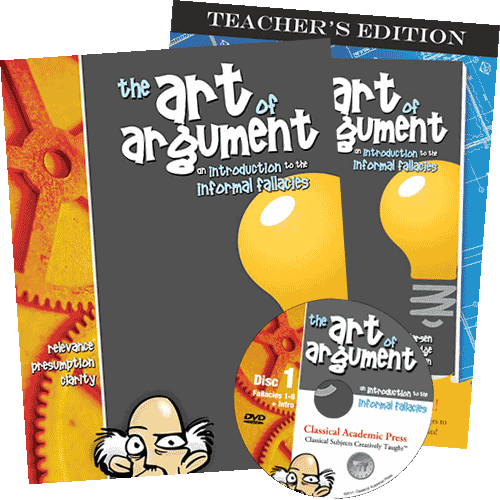
I've had my eye on this program, with the intention of using it next year with Luke and Ezekiel.  If they're going to argue with me, I think we should at least follow some rules, right?  I was very excited to when the opportunity arose for me to review it.  I received the textbook, the Teacher's Edition, and the first disk from the DVD set.

There are 28 fallacies covered in this program, and they're divided into six chapters:  Ad Fontem Arguments,  Appeals to Emotion, Red Herrings, Fallacies of Presupposition, Fallacies of Induction, and Fallacies of Clarity. At the end of each chapter, there is a chapter review, along with a cumulative review worksheet (for chapters 2-6).  The six chapters are divided into 3 units (Relevance, Presumption, and Clarity), and these sections give an overview of the fallacies that will be discussed.  The Teacher's Edition includes a copy of the textbook with the answers filled in, tests and answers for each chapter, each unit, and a final exam on all the material.  There is enough material here for a full year of informal logic study.

To use this program, we read through the fallacy, watched the DVD segment (a teacher discussing the fallacy with 4 students around a table) relating to the fallacy, and then discussed the fallacy. In the text, each fallacy is explained and there are examples that the text helps you work through.  There are also advertisements (created by Classical Academic Press) that provide discussion points for the fallacy.  Most of the fallacies end with a "Fallacy Discussion", where the student is expected to point out the fallacy on their own and explain it.  There are lines provided in the text to write an answer down, but we chose to do it orally.  It took us about 30 minutes to work through the fallacy and discussion.  The DVD segments take an additional 15 to 30 minutes to watch.

We really enjoyed using The Art of Argument, and I think it's a fabulous informal logic program.  It is recommended for 7th and up, and I think that's a pretty accurate recommendation, though some 6th graders will be able to do the program just fine.  I would definitely recommend the textbook ($21.95) and the Teacher's Edition ($24.95).  The DVDs ($54.95) are not necessary, and my sons had mixed opinions about them.  Luke thought they were boring (so did I), but Ezekiel enjoyed them.  If you choose to purchase all three items, they are available bundled together for $88.95.  Check out the Classical Academic Press website for samples and ordering information.

For additional reviews of The Art of Argument, go here.


Photobucket 


  Disclaimer:  As a member of the TOS Crew, I received this product, at no cost to me, in exchange for an honest review.  All opinions are mine.