Showing posts with label Art. Show all posts

Monday, August 04, 2014

Review: Old Western Culture-The Greeks

Every now and then a product comes along that really, really excites me.  Roman Roads Media has released one of these products:  Old Western Culture:  The Greeks.  The subtitle to this DVD course is "A Christian Approach to Great Books".

That's right--I said a DVD course that is a Christian approach to Great Books.  Now maybe you understand my excitement!

Way back when I was just starting our homeschool journey with Luke, I knew I wanted to give my sons an education using the Great Books as they entered Junior High & High School.   As time went on I never waivered in this goal, but our family ended up consisting of five closely spaced sons, I ended up with a chronic autoimmune liver disease, and last December I felt like God was nudging me to take a part time job at our church.  Combine these circumstances with the fact I did not receive the kind of education I wanted to give my boys, and I was struggling to provide what I'd hoped to. 

Enter Wesley Callihan & Roman Roads Media.


Wes Callihan is the highly qualified teacher on The Greeks DVDs.  He has a degree in history, has taught in many classrooms, has written Great Books study guides for Veritas Press, speaks at homeschool conferences, and is founder of  Schola Classical Tutorials.  All this to say, he is passionate about the subject matter he teaches.  His love of the Great Books shines through, and he's a wonderful teacher.
 
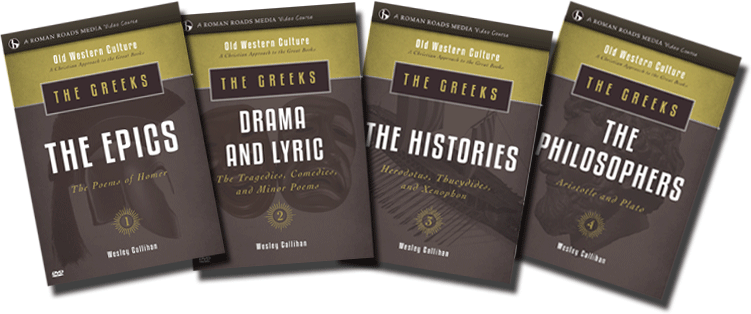
What exactly is Old Western Culture: The Greeks?  It is a four part DVD series that is a complete literature and social studies course for students in grades 8 and up.  This program was created for homeschoolers, so it is extremely homeschool friendly.  Each unit has 12 video lessons that are about 30 minutes each, for a total of 48 video lessons.  These video lessons aren't boring lectures, either.  As mentioned above, Wes Callihan is an engaging teacher who loves and knows the subject matter, and the lessons are full of wonderful graphics and artwork.

Each of the following four units can also be used as a stand alone unit, and as such, they can be used in any order:
  1. The Epics:  The Poems of Homer
  2. Drama and Lyric:  The Tragedies, Comedies, and Minor Poems
  3. The Histories:  Herodotus, Thucydides, and Xenophon
  4. The Philosophers:  The Works of Plato and Aristotle
If you do all four units, your child will read Homer, Plato, Aristotle, Herodotus, Thucydides, Sophocles, and more throughout the year.
 
In addition to the instruction, each part contains a PDF workbook, a Teacher's Edition, and needed texts in PDF format.  There is also an exam for each part, and writing assignments for your student.  Each DVD unit also contains a "Guide to the Art" booklet.  For $224, you have access to all that you need for the year.  Roman Roads does suggest that you purchase physical copies of the books read throughout the course, but if you choose not to, everything you need is included.

You can also purchase copies of the workbook if you'd rather not print them.  I received a hardcopy of The Histories workbook.  It is a spiral bound black and white workbook (with a color cover), and the answers are in the back of the workbook.  I have a black and white laser printer, and for our family I see no benefit in ordering a pre-printed workbook.  However, if you choose to do so, this is a quality product.


Now that I've described what it is, how does it work?  Luke and Ezekiel both fall in the suggested age range, and we began with the first unit, The Epics.  In this unit, your student will read both The Iliad and The Odyssey.  This unit has a schedule available for download on the Roman Roads website, while the other units have a schedule printed in the included Art Guide.  This schedule shows a recommended nine week schedule, working 5 days a week.  We followed this schedule pretty closely (we began with The Epics unit), though since it is summer we didn't always work 5 days a week. 

The first lecture of each unit is an introduction to the topic of the unit.  After watching the introduction, there are study questions in the student workbook for the student to answer.  An important point to note is that on each DVD there is a link on the menu for the study questions.  If your student has any trouble answering the questions, they can simply go to the study question link, find the appropriate question, and re-watch the pertinent portion of the DVD lecture.

After the introductory lesson, the student then begins to read the books for the unit.  Some days the student simply reads; other days the student will answer questions in the workbook about their reading; other days they will watch a video lecture about what they are reading and will answer questions in the workbook about the lectures.

The student is asked to write one paper for each unit.  According to the recommended schedule, they should take about 3 weeks to write the paper.  It is suggested that the paper be about 750-1200 words long.  In each workbook, there are several discussion questions, and if your student is struggling to come up with a thesis statement, they can use the discussion questions as a starting point for their paper.

Each unit also has a final exam.  These are available on the Roman Roads website.  If your student doesn't make a satisfactory grade on the exam, Roman Roads provides an exam B on the website as well.

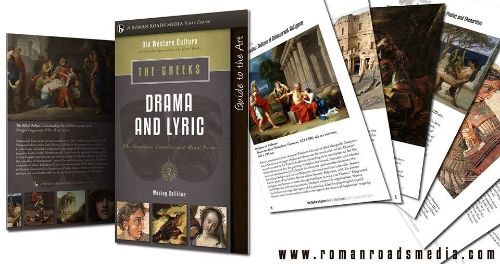
I mentioned above that there is a "Guide to the Art" booklet included, and that the DVDs have wonderful artwork.  Throughout the lectures, related artwork is shown on the screen.  The "Guide to the Art" booklet contains full color reproductions of all this artwork, along with the title, artist, and information about the artwork and/or artist, meaning there is a mini art history course included as well.


Two years ago, Luke, Ezekiel, and I studied the ancients.  We were supposed to read The Odyssey, but I was intimidated.  It is not a skinny book, and it's not written in a style that I'm comfortable with.  This meant I was unsure how to approach this book with them, so we skipped it.  However, now that we're going through The Iliad with Wes Callihan, I look forward to tackling The Odyssey next with the boys.

While you could turn your student loose with the DVDs and reading, the parent is encouraged to watch the lectures and have discussions with their child.  I like that following this model, we are all learning together.  During one of our first discussions using the discussion questions in the workbook, the boys assumed I had the answers in my notebook.  The discussion questions do not have answers in the Teacher Edition, which meant (as I had to explain to them) that I was having to use my brain to think about and discover answers alongside them.  

Luke and Ezekiel are both very good readers, however Luke tends to be a slower reader.  The amount of reading is stretching Luke (in a good way), and having the suggested schedule helps me to see what a reasonable amount of reading is for a typical student.  We have found that following the schedule means that we're working on this 60-90+ minutes a day.  I think this is a fabulous use of our time, though, considering all that we are learning.

I appreciate that the program approaches these Great Books from a Christian perspective.  It is recognized that even though the authors were not believers, they still had worthwhile thoughts and ideas and is not afraid to tackle these head on, using a Christian worldview.

We're all enjoying this program, and we're all learning so much.  This program has made doing a Great Books study possible for our family; not only has it made it possible, it has made it possible to do it well and I am so excited about continuing with the next 3 years (The Romans, Christendom, and Early Moderns) of Old Western Culture.

Click to read Crew Reviews
 
 
Crew Disclaimer

Tuesday, April 29, 2014

Review: ARTistic Pursuits

Jacob loves to draw, and does so quite a bit in his spare time.  As much as I appreciate the benefit of art, we've never really done it as an official part of our homeschool.  Jacob was pretty excited when the opportunity to review a book from ARTistic Pursuits became available.  He looked over the options, and chose Elementary 4-5, Book 2:  Color and Composition.

This book is priced at $47.95.  While this particular book is for grades 4-5, ARTistic Pursuits has books available for preschool through high school. What caught my attention is that the book is written to the student.  All I had to do was gather the supplies and tell Jacob to have at it.  It is suggested that you schedule an hour twice a week for your student to complete the lessons.

ARTistic Pursuits Review
 
 
To use Elementary 4-5, Book 2:  Color and Composition, you will need:
  • Watercolor pencils (set of 12)
  • #8 watercolor brush round
  • watercolor paper pad
  • sketch pad
  • vinyl eraser
  • metal handheld pencil sharpener
  • Prismacolor colored pencils (set of 12, optional)
  • can or jar for water container
  • masking tape
  • paper towels
  • tracing paper
To make it easy to get the right supplies, there are art supply packs available at Dick Blick.  However, you can also easily pick up the needed supplies at a craft or hobby store.

ARTistic Pursuits Review
 
 
There are 16 units in the book, and each unit is broken down into four lessons:
  1. The first lesson of each unit focuses on "Building a Visual Vocabulary".  The topic of the unit is explained to the student, and they are given a creative exercise to do. 
  2. The second lesson of each unit focuses on "Art Appreciation and Art History".  In these lessons, the student is exposed to great works of art that use the topic they are focusing on in the unit.  They then apply what they've learned by creating another piece of artwork. 
  3. The third lesson of each unit focuses on "Techniques".  Much as you'd expect by the title, the student learns different art techniques and uses them to create more orignal artwork. 
  4. The fourth lesson of each unit focuses on "Application".  Here the student completes a final project using what they've learned in the unit.
For example, the first unit is on the Color Wheel:
  1. In the first lesson, your student is introduced to and shown the color wheel.  They are exposed to primary and secondary colors.  The purpose of the assignment is to get your student to relax and observe, and they are instructed to watch an activity that allows their mind to wander.  After a bit, they are told to pick up paper and pencils and to draw what they see. 
  2. In the second lesson, the piece of art "The Oregon Trail", is printed in the book.  There is a short biography of the artist, Albert Bierstadt, and a paragraph about the time period in which the work of art was created.  The student is instructed to study the color in the art, and it's pointed out how the artist used different colors, such as gold, orange, and purple, to create the mountain, which we normally think of as brown.  Their assignment is to sketch a landscape scene and color it with watercolor pencils, using a paintbrush to blend the colors.
  3. In the third lesson, the student is taught how to use watercolor pencils.  The assignment for this lesson is to choose something, draw it with watercolor pencils, and use the technique they learned to add water with a brush to paint.
  4. The final project in the fourth lesson is to paint a landscape scene, paying attention to the colors and technique learned in the unit.

Other projects your student will complete throughout this book are: drawing a picture from a photograph, using a technique to layer colors to create brighter colors, studying an object (like an animal) from the front and back and then drawing both points of view, drawing a figure, keeping correct proportions, and using colored pencils to draw a picture using marks to show texture.

This book is full color, and all of the artwork and pictures and lessons are in color.  It's easy for your student to figure out what their project for each lesson is, because all of the assignments are printed in blue.

As instructed, I gave the book to Jacob and told him to work through it.  He really enjoyed using it, having art as an "Official School Subject", and learning how to use watercolor pencils to color in his artwork.  When asked, he said "The book was fun, and it did a really great job of teaching me how to do stuff."  I liked that it required none of my time, and since we've been studying American history this year, it was nice that the artwork featured throughout the book are from American artists.  

Here's a sample of Jacob's work:


Click to read Crew Reviews
 
 
Crew Disclaimer

Saturday, April 26, 2014

When Pigs Fly

Micah brought this little pig home this week. He made it at the enrichment program he attends.


"It's a flying pig.  It flies using its ears." --Micah, age 10 


Tuesday, July 09, 2013

Review: Classical Conversations PreScripts

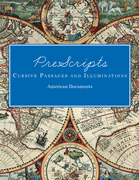
Many homeschoolers have heard of Classical Conversations.  They are best known for their communities across the country, where parents and children gather together to study and learn using a classical education model.  They've recently designed a series of four cursive books, called PreScripts, that combine art and penmanship.  We received PreScripts Cursive Passages and Illuminations, which is the 4th book in the series.


The PreScripts books increase with difficulty as you move through the four books.  The first book begins with letter formation and coloring, while the fourth book has your child copying passages from American documents and creating illuminated letters (using the Zaner-Bloser style of cursive).  These books are not labelled with grade levels, though there are general age guidelines for each book (Cursive Passages and Illuminations is recommended for ages 9 through high school).

We're starting our new school year, and we're studying American history this year. Cursive Passages and Illuminations was a wonderful fit for our family, since it uses passages from American documents as copywork.  Your child will copy the Declaration of Independence, the Monroe Doctrine, the Gettysburg Address, Reagan's Speech at Brandenburg Gate ("Mr. Gorbachev, tear down this wall!"), along with many other important and memorable writings and speeches from American history.  After each page of copywork, the facing page has an illuminated letter for your child to copy. You can check out sample pages here.

Priced at $12.99, this book is a bargain.  The quality is impressive:  a thick and shiny cover, heavyweight paper inside, and a spiral binding so the book lays flat.  It can be used as a consumable workbook, or your child can copy the passages and illuminations into their own notebook. 

I used this with all 5 of the boys.  In the preface of the book, it is stated that "The key to good writing is daily practice".  Keeping this in mind, I had my boys practice for 10 minutes a day (I knew some of my boys would balk at having to copy an entire passage--some are quite long).  The first thing I had them do when they began a new page was to read what they were copying, since reading cursive still requires them to think through the letters.  After they read, I had them copy the passage, in their best cursive, for 10 minutes.  I told them it didn't matter how far they got, as long as they were doing their best work.  After they finished the passage, they then spent their 10 minutes of penmanship practice time working on their illuminated letters.

The boys enjoyed this copybook.  The illuminated letters were a reward; they enjoyed the break of having to write.  I liked that even though they weren't writing, they were still using the same fine motor skills they need for penmanship.  It's nice having ready made copywork that coordinates with our studies as well.  If you're looking for a fun and creative way to practice and teach cursive, check out the line of PreScripts books from Classical Conversations.


For more reviews of Classical Conversations PreScripts books (all levels) , visit the Schoolhouse Review Crew.


Photobucket


 photo Disclaimer2_zpsff718028.gif

Thursday, May 30, 2013

Review: See the Light Cartooning

My latest review for the Schoolhouse Review Crew is Cartooning by See the Light.  This DVD is $14.99 and is about an hour long.  It can be used with all ages.


See the Light is the brain child of Dave and Pat Holt.  Through art and music, they share the truth of th gospel with children.  In addition to this Cartooning DVD, they have other project based art DVDs available.  Pat Knepley is the Master Artist on the Cartooning DVD.  She'll guide you and your children through classical cartooning, along with the art elements line, space and shape and the concept of exaggeration and movement.

We spent a Monday afternoon doing art.  All five boys worked through the lesson, and their ages are 13, 12, 10, 9, and 7.  At the end, everyone had a few pages of characters they had drawn.  After we watched and cartooned along with the DVD, I gave each of my boys an index card and told them to write down three opinions of the program.  The didn't talk to each other before they wrote down their opinions, but they all had similar thoughts.

Pros:
  • Fun
  • Learned some new techniques
  • Helpful
  • Learned new ideas for characters
Cons:
  • It was long
  • Concepts were over-explained

Overall, it was an enjoyable experience.  If you're looking for a something fun to add to your homeschool, I'd check out the DVDs from See the light.


For more reviews of See the Light, visit the Schoolhouse Review Crew.


Photobucket


 photo Disclaimer2_zpsff718028.gif